Trump, Putin to Talk as Ukraine, Europe Push for Immediate Ceasefire
Robyn Dixon, Serhiy Morgunov, Ellen Francis and Michael Birnbaum The Washington Post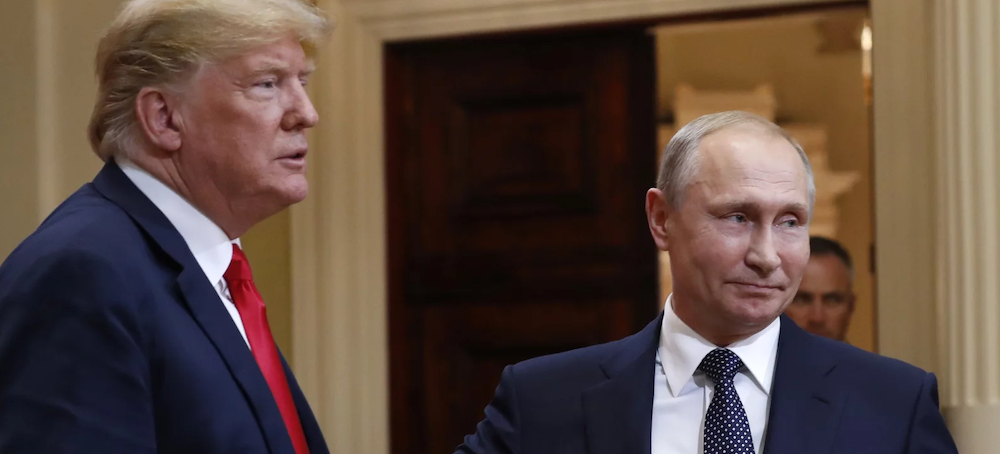 President Trump, left, and Russian President Vladimir Putin. (photo: Pablo Martinez Monsivais/AP)
European leaders spoke with President Donald Trump on Sunday to urge him to pressure Vladimir Putin to agree to a 30-day ceasefire in Ukraine.
The call comes after one of Russia’s largest drone assaults on Ukraine — nearly 400 launched over the weekend — and a flurry of diplomacy, as Ukrainian and European officials sought to convince the Trump administration of the need for an immediate, unconditional ceasefire and to ramp up pressure on Russia to take serious steps toward peace.
Trump has framed the peace agreement as a negotiation primarily between Moscow and Washington, raising concerns that the two leaders could agree on a deal that suits Russia but fails to protect Ukrainian security and independence, setting the scene for another Russian invasion in the future.
On Friday, Russia and Ukraine held their first direct talks since the early weeks of the war, but aside from a prisoner swap, they agreed only to continue negotiating over a possible ceasefire. Trump endorsed the talks but then diminished their importance before they began, declaring that nothing would be resolved until he and Putin spoke directly.
Speaking before the phone call from Air Force Two, Vice President JD Vance told reporters that “we want to see outcomes.”
“We realize there’s a bit of an impasse here, and I think the president’s going to say to President Putin, look, are you serious? Are you real about this?”
He said that participants needed to move past the mistakes of the past and “if Russia is not willing to do that, then we’re eventually just gonna have to say, this is not our war.”
Vance has previously threatened that the U.S. would walk away from the negotiations. On Friday, White House spokeswoman Karoline Leavitt said “the president has made it clear his goal is to see a ceasefire and to see this conflict come to an end and he’s grown weary and frustrated with both sides of the conflict.”
Despite concessions from the Trump administration, Putin has repeatedly brushed off pressure for an unconditional 30-day ceasefire, and Ukraine is prepared for the likelihood that Putin would continue to drag out the process, pushing for conditions that Kyiv sees as unacceptable, Ukrainian officials said.
“We have conveyed to the American side — and we are convinced this is true — that Ukraine has taken far more real steps toward peace than Russia,” a Ukrainian official familiar with the negotiations said Monday, adding that the phone call was an important attempt to reinvigorate the peace process.
“Ukraine seeks a complete and unconditional ceasefire for an extended period. In other words, we aim to stop the killing, as President Trump puts it, and we fully share this logic. The killing must stop, and only then can the peace process move forward,” he said, speaking on the condition of anonymity because of the sensitivity of the matter.
Russia targeted Ukraine with at least 112 drones overnight Sunday into Monday, following the largest drone attack since 2022 on the previous night, when Russia fired 273 drones, killing 27-year-old Hanna Yefimenko as she shielded her 4-year-old son Marko, who was also injured, in the town of Vasylkiv, southwest of Kyiv.
Oleksandr Serhiyovych, 40, a neighbor of Yefimenko, said the boy had sustained an eye injury.
“I can’t even imagine how this war will end. This isn’t life. I have nothing to say until this war is over — because right now, life doesn’t exist,” he said.
Another resident, Serhiy Boiko, 37, whose house was destroyed in the attack, said Trump had failed to stop the war and expressed exasperation at the whole process of talks.
“During these so-called ceasefires, they just build more drones, and then civilians end up paying the price. What we need is real peace and some kind of security — real security guarantees.”
Trump said he would talk to Zelensky and NATO leaders after speaking to Putin — his third conversation with the Russian leader this year.
With Putin projecting confidence of victory over Ukraine, Russia has so far tried to use the peace talks to achieve what it has not been able to gain through its invasion, repeating its demand Friday that Ukraine give up land not even occupied by Russia and threatening to wage war for decades if necessary.
“Certainly, we’d prefer to achieve our goals by political and diplomatic means,” Kremlin spokesman Dmitry Peskov said Monday. He said Russia launched its 2022 invasion after NATO refused to accept Russian demands.
“However, if the U.S. mediation efforts, which we value highly and are grateful for to the American side, really help us achieve our goals by peaceful means, well, naturally, this is preferable,” Peskov said.
Trump and other U.S. officials have threatened tougher sanctions against Russia if Putin shows he has no genuine interest in peace, but the Trump administration has so far done little to increase the pressure on Russia, instead pressing Ukraine to give up territory occupied by Russia and to accept that it will not be able join NATO.
Kyiv officials are hoping Trump will insist that Putin accepts an unconditional ceasefire, but that appears a long shot given that Putin has repeatedly ruled this out. He has set tough conditions, including a halt to Western arms deliveries to Ukraine and a bar on Kyiv recruiting for its military.
These conditions would give Moscow a major advantage, including the potential to rebuild its own military capacity before possibly resuming hostilities. Russia has recently massively boosted its military recruitment, and its factories continue to pump out weapons and ammunition.
As part of the diplomatic efforts on the weekend, Vance and Secretary of State Marco Rubio met Zelensky in Rome on Sunday. Ukrainian presidential chief of staff Andriy Yermak said they had “a very substantive conversation.”
Zelensky said he emphasized the importance of a full, unconditional ceasefire as soon as possible.
“Pressure is needed against Russia until they are eager to stop the war. And, of course, we talked about our joint steps to achieve a just and durable peace,” Zelensky wrote on X.
Also Sunday, British Prime Minister Keir Starmer, French President Emmanuel Macron, German Chancellor Friedrich Merz and Italian Prime Minister Giorgia Meloni spoke to Trump by phone, warning against rushing into a deal without substantial Russian concessions.
“The leaders discussed the need for an unconditional ceasefire and for President Putin to take peace talks seriously,” Starmer’s office said afterward. They discussed using sanctions “if Russia failed to engage seriously in a ceasefire and peace talks.”
Before last week’s talks in Istanbul, European officials had been hopeful that their diplomatic efforts could persuade the Trump administration to give Russia an ultimatum: Accept a 30-day ceasefire or face fresh sanctions.
Zelensky and European leaders believed that Trump was leaning toward new sanctions if the Kremlin rebuffed U.S. calls for an immediate ceasefire last week, according to three European diplomats who spoke on the condition of anonymity to discuss a sensitive matter. But Friday’s ultimately inconclusive talks in Istanbul, called for by Putin and backed by Trump, sidetracked those plans.
European leaders blasted Russia’s demands at the Istanbul talks and have maintained threats of more U.S. and European sanctions if Russia continues to reject a ceasefire.
But the U.S. flip-flopping has baffled officials and left them wondering whether Trump will follow through on pressuring the Kremlin into a truce.
Some Ukrainian politicians were also pessimistic that Trump’s phone call to Putin on Monday would produce any positive results, noting that the U.S. president often backs his Russian counterpart’s views after they speak.
“For some reason, Trump believes he has a good relationship with Putin, while in reality, Putin is simply using him and even humiliating him, trying to show that Trump is neither consistent nor a strong leader,” said Oleksandr Merezhko, a Ukrainian lawmaker and chairman of parliament’s foreign policy committee.
The Kremlin has so far succeeded in offering just enough progress to avoid being blamed by Trump for refusing an unconditional ceasefire. Last week’s peace talks did lead to agreements to swap 1,000 Russian prisoners of war for 1,000 Ukrainian ones and to continue talking.
In Rome on Sunday, the head of the E.U.’s executive branch, Ursula von der Leyen, said this week would “be crucial” in the peace process.
While the Istanbul talks upended Europe’s plans for ultimatums, one European diplomat said Washington has not abandoned the prospect of sanctions in the bid for a ceasefire. “The Americans are seriously thinking about raising the pressure on Russia,” he said, “especially if this war drags on for weeks.”