Sudan’s Military Recaptured a City. Bodies Soon Filled the Streets.
Katharine Houreld, Hafiz Haroun and Jonathan Baran The Washington Post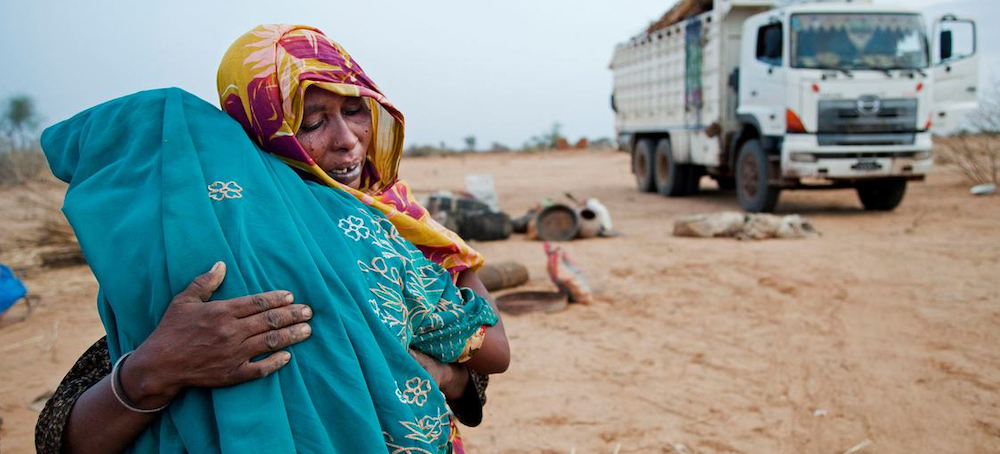 People continue to be displaced by conflict in Sudan. (photo: Albert González Farran/UN)
Videos verified by The Post show retaliatory killings by Sudan’s military after it recaptured the southern city of Wad Madani from the RSF paramilitary.
These and other terrifying scenes of retaliatory violence captured on video and verified by The Washington Post reveal what happened last week after Sudan’s military recaptured the southern city of Wad Madani, which had been under the control of the Rapid Support Forces paramilitary for a year.
The war between the military and the RSF, which began in April 2023, has unleashed chaos and suffering across Sudan. At least 150,000 people have been killed and more than 11 million forced from their homes. The U.S. government has accused both sides of war crimes and recently imposed sanctions on the two men whose rivalry has torn the nation apart. Last week, the U.S. Treasury sanctioned the head of the RSF, Gen. Mohamed Hamdan Dagalo, universally known as Hemedti, and on Thursday announced similar measures against Gen. Abdel Fattah al-Burhan, the Sudanese military chief.
The conflict has raged mostly beyond the public eye: Access to battlegrounds is severely restricted, and large swaths of the country have no internet or phone access. With communications down in Wad Madani, The Post was not able to reach people still inside the city, making it difficult to assess the full extent of the army crackdown. But one exiled resident, who had spoken to family members who fled, alleged widespread arrests and killings by military forces. His brother had been taken, he said, speaking like others interviewed for this report on the condition of anonymity for fear of retaliation. Another resident who had escaped the city said relatives of suspected RSF recruits had been targeted.
“When the RSF took over this village, they told other people to get out,” the resident said. “So some people joined the military when they arrived and took revenge on the RSF.”
The footage that emerged from Wad Madani — and other locations where the army has made recent gains — prompted a rare statement from the military Tuesday, in which it condemned acts of violence but stopped short of accepting responsibility.
“The Armed Forces condemns the individual violations that have recently occurred in some areas of Al-Jazirah state following the liberation of Wad Madani city,” the statement said. “At the same time it affirms its strict adherence to international law and its keenness to hold [accountable] anyone involved in any violations.”
The videos — geolocated and verified by the London-based Center for Information Resilience (CIR) and subsequently verified by The Post — are graphic. In one, a young man is lying in the road, his face covered in blood, pleading for his life. Men in uniform question him about an individual he identifies as his father. He curls up as the uniformed men step back and open fire; around 30 shots slam into his body. “Allahu akbar!” yells someone in the background — “God is great.” Behind him, bodies of young men are sprawled among derelict cars, some with the eyes still open. A toothbrush and toothpaste lie next to one, and another has a cast on his leg. At least 19 bodies can be seen; no weapons are visible.
In another video shot nearby, close to a crude checkpoint made of oil drums and old tires, at least 48 young men lay motionless — many lined against the wall of a compound, some next to a blue water tanker. Several have visible bullet wounds to the head. Their identities are unclear. All are shoeless and in civilian clothes.
In other videos, where soldiers identify themselves as being in Wad Madani or the nearby settlement of al-Keriba, civilians are seen sitting down under armed guard or jogging through the desert, blindfolded and tied to one another.
In a third video geolocated by The Post, soldiers throw a man in civilian clothes screaming from Hantoub Bridge near Wad Madani. Researchers from CIR identified patches on the soldiers’ uniforms that indicate they are from forces affiliated with the military, including the Islamist Barra’a Ibn Malik brigade, the General Intelligence Service and the Special Mission Forces.
“Beat the animal,” taunts a voice off camera as a rope is forced into the man’s mouth like a bridle, according to CIR. “Come on, run, run. … In revenge for all our martyrs, in revenge for all our martyrs. … Beat the gay ‘Um Kaukat,’” he says, using a slang term for the RSF.
As part of the sanctions levied against Hemedti, Secretary of State Antony Blinken said the RSF leader’s forces were committing genocide, a rare declaration by Washington.
“The RSF and allied militias have systematically murdered men and boys — even infants — on an ethnic basis, and deliberately targeted women and girls from certain ethnic groups for rape and other forms of brutal sexual violence,” he said in a Jan. 7 statement.
Burhan, the army chief, is accused by the United States of presiding over attacks on civilians and denying food aid to the displaced in the face of a rapidly spreading famine — contributing to what Blinken has called the “world’s worst humanitarian crisis.”
The latest violence lays bare the ethnic and economic fault lines in Wad Madani, at the center of Sudan’s agricultural heartland. Sudanese media and the former resident quoted earlier said many of the victims were migrant workers known as “kanabi,” after the Arabic word for camps. Many kanabi come from neighboring South Sudan — which declared independence from Sudan in 2011 after decades of civil war — or migrated generations earlier from the western region of Darfur and have traditionally had no land and no political rights.
The RSF, despite its genesis as a violent tribal militia and its leader’s multibillion-dollar business empire, has tried to present itself as a champion of Sudan’s poor and marginalized communities — including the kanabi — facing down the country’s military elites. So when soldiers arrived in Wad Madani and the surrounding areas, the former resident said, they targeted kanabi homes.
In the Qambo area near Medina Arab, about 20 miles east of Wad Madani, military personnel arrested many people and looted property, the former resident said. In Halima camp, just south of Gezira University, at least 12 people were killed, he said, providing photographs of burned and bloodstained bodies that The Post was unable to verify.
The Kanabi Conference, which represents the group, alleged in a statement Thursday that “on Jan. 9, a massacre took place in Camp Taiba, east of Umm Al-Qura, which included the burning of two children inside homes, the assassination of six other people, and the kidnapping of 13 women.”
A resident of a village close to the Taiba camp said several local men there had joined the RSF. When the military arrived, he told The Post in a message, they killed six men related to the RSF recruits, arrested their families and took their property. Other villagers were not targeted, he said.
Sudan’s conflict is spilling across its borders, further destabilizing some of the world’s poorest and most violent countries. Arms and mercenaries have poured into Sudan — from Chad, Libya and the Central African Republic. Millions of refugees have fled out of Sudan — into Egypt, Chad, Ethiopia and South Sudan.
The violence around Wad Madani has sparked retaliatory attacks against Sudanese refugees in South Sudan. A resident in the capital, Juba, reported riots and machete-wielding mobs hunting Sudanese refugees Thursday. A Sudanese refugee in the town of Wau said that anyone who looked Arab was attacked in the market and that shops were ransacked. South Sudan’s president has called for calm, and police have imposed a nationwide dawn-to-dusk curfew.