Sudan Is Being Ravaged by a Civil War the World Has Overlooked
Simon Marks Bloomberg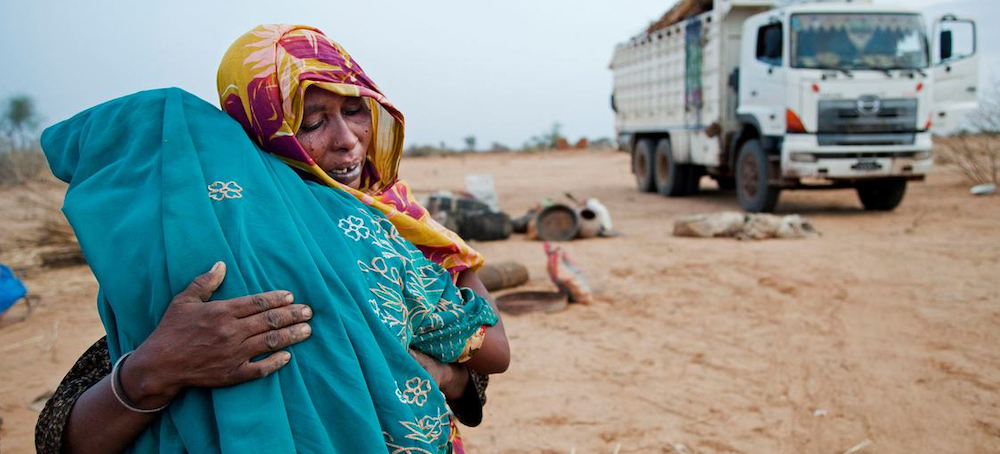 People continue to be displaced by conflict in Sudan. (photo: Albert González Farran/UN)
Millions have fled their homes, leading to what the United Nations has described as the world’s biggest displacement crisis. Eclipsed by wars in Ukraine and Gaza, this is a humanitarian disaster that rarely makes headlines.
International donors have committed far more aid to Kyiv than they have to the North African country. The United Arab Emirates and Iran have been accused of providing weapons and financial backing to the warring sides, undermining efforts by the US and Saudi Arabia to broker a ceasefire.
How did the unrest in Sudan escalate?
Sudan’s military, long the country’s pre-eminent power broker, propped up dictator Omar al-Bashir for three decades before ousting him in 2019. In 2021, the army, led by Lieutenant-General Abdel Fattah al-Burhan, toppled an uneasy transitional coalition of civilian and military figures. That coup sparked new unrest and a deadly crackdown by security forces.
With the generals in near-total control, a long-running rivalry came to the fore between the military and a powerful militia known as the Rapid Support Forces, which had helped to overthrow Bashir. Violence erupted after the army proposed that RSF members be absorbed into the regular security forces, with the militia’s leader reluctant to relinquish its independence.
Why has the civil war in Sudan continued for so long?
Mediators, regional officials and diplomats say the involvement of external actors has perpetuated and exacerbated the violence.
The Sudanese government severed official ties with the UAE in May over what it described as “ongoing aggression” in the civil war, accusing the Gulf nation of supplying the RSF with weapons. UN experts and US congressmen have echoed the allegation that Abu Dhabi is backing the militia group. UAE officials have repeatedly denied any involvement by their country. Iran, meanwhile, has supplied Sudan’s army with combat drones and other support.
Is either side winning in Sudan’s civil war?
Sudan’s military appeared to have the upper hand by March 2025 after pushing the RSF back in large parts of the country and recapturing control of capital city Khartoum, although the RSF retained control of most of the western Darfur region.
The fighting entered a new phase in May when the militia used drones to attack Port Sudan, a key trade hub that lies on the Red Sea and serves as the army’s de-facto seat of government, and the nearby Flamingo Bay naval base. Fuel storage depots, power lines and other infrastructure were damaged, and aid distribution was disrupted. Up until then, Port Sudan had been spared and was a haven for Sudanese fleeing violence elsewhere.
Sudanese Militia Attacks Main Port on Red Sea Coast
Airport, harbor in Port Sudan struck in pre-dawn attack
Analysts have raised the prospect of Sudan entering a Libya-type scenario, in which the country ends up split into two separate zones of control.
Who are the Rapid Support Forces?
The RSF has its origins in the government-backed janjaweed militias that terrorized Darfur in the early 2000s. It’s led by one-time camel trader Mohamed Hamdan Dagalo, a former enforcer for Bashir who helped overthrow the dictator. Dagalo then became deputy of the quasi-presidential Sovereign Council, making him Sudan’s de-facto second-in-command.
Though lacking serious air power and tanks, the RSF is a seasoned fighting force. It was estimated to have as many as 70,000 fighters at the onset of the war, although the extent to which the fighting has depleted its ranks is unclear. The US sanctioned the RSF and Dagalo in January 2025 after determining that the group was guilty of genocide.
What’s been the fallout of Sudan’s civil war?
In a nation of almost 50 million people, about half are facing extreme hunger, according to the UN. Famine has been documented in 10 locations. Some 12 million have been displaced and Chad, Egypt and South Sudan have all seen a large influx of refugees. Humanitarian groups say their access to the conflict zones is almost non-existent.
Extreme violence has rocked Darfur, evoking memories of the yearslong conflict that erupted there in 2003, in which civilians were targeted based on their ethnicity. Widespread attacks and sexual crimes against women and girls have also been documented. Sudan is among the world’s poorest nations, coming in 176th out of the 193 countries ranked in the UN Development Program’s human development index.
What are the international stakes in Sudan’s civil war?
Under Bashir, who seized power in 1989, Sudan became internationally isolated. He spearheaded an Islamist revolution that turned the country into a haven for terrorists such as Osama bin Laden in the 1990s. The International Criminal Court indicted Bashir for alleged war crimes and genocide in Darfur, but the military refused to hand him over to stand trial and his whereabouts have been unknown since the war started. After his removal, the US rescinded its three-decade listing of Sudan as a sponsor of terrorism and it was gradually re-embraced by Western countries, which saw it as a potential new ally in Africa.
China, which has backed port and rail projects in Sudan, also has an interest, as does Russia, which is trying to bolster its influence in the continent after being ostracized by the US and European Union over its invasion of Ukraine. Russia’s now-defunct mercenary company Wagner Group has been involved in Sudan’s gold-mining sector.
What does Sudan’s civil war mean for the region?
The violence is among a string of setbacks for democracy in Africa. There were nine successful coups in the region across 2020 to 2023, as well as five failed attempts, and Mali, Burkina Faso, Guinea and Niger are among the countries that remain under military rule.
There’s a risk that the fighting in Sudan, which has seen countless insurgencies in its decades of independence, could draw in its neighbors, whether directly or through the backing of proxy forces. That would have potentially grave implications for regional security and place millions more lives at risk.